
Heart Screening for sports clubs
For young people playing at all levels of sport
Why heart screening is important for young people involved in sport
Major UK sports bodies, including The Football Association and Rugby Football Union, provide ECG screening for their academy players as standard. At the Young Hearts Project our aim is to enable sports clubs playing at all levels to benefit from the same opportunity to protect their members.
The importance of heart screening is recognised:
“…non-negotiable from the RFU that all Premiership Academy PDG players [16-18] have ECG screening”
Rugby Football Union
“Each year, around 1,300 academy players aged 16, undergo screening at Premier League, Championship, League One, and League Two academies.”
Football Association
“We strongly advise for athletes aged 16 years and over on an England/GB to have undertaken cardiac screening”
England Hockey
Our heart screening service
Young Hearts Project provides a one-off mobile heart health screening service to sports clubs for young people aged 16 – 35 years. It includes:
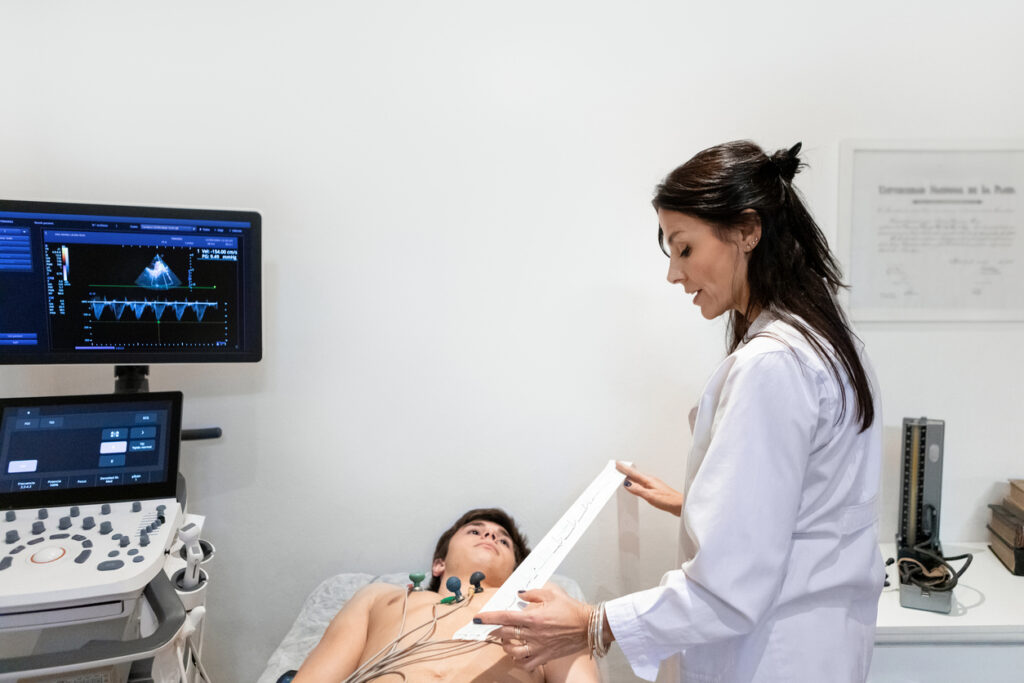
An ECG test
The standard of care test for checking heart rhythm, rate, and electrical activity to determine whether cardiac health is normal
A heart auscultation
Listening to the heart with a stethoscope to rule in or out the presence of a heart murmur.
Our one-off screening service is comprised of 2 steps:
Step 1: The clinic
- Run onsite at the sports club or other suitable local site by Young Hearts Project’s team of cardiologists, nurses, and clinic managers.
- The session takes around 10 minutes.
- In advance, individuals undertake a health questionnaire.
In the clinic, individuals will undergo:
- A 12-lead electrocardiogram (“ECG”) test
- Clinical examination: a stethoscope heart auscultation to exclude a heart murmur with an experienced cardiologist
Step 2: Post-Clinic Review & Recommendation
- Test clinic findings are assessed by a qualified cardiologist with a report given to the individual and their parents/guardians if under 18 years old within ten days.
- Most individuals will have normal results (~96-98% cases).
- Where any abnormalities are detected (2-4% cases) then the results are assessed by our Chief Medical Officer alongside an advisory group with leading expertise in key areas of cardiac screening and the subspecialities within cardiology (Electrophysiology, Cardiac Imaging and Inherited cardiac diseases).
This approach ensures we can deliver clinical excellence and provide additional support for young people and families where needed. Any complex cases will go through a multidisciplinary team meeting (MDT) which is the current standard of care within best health care practise.
- Young Hearts Project’s protocol will lead our medical team to recommend the best course of action for every individual and their parents/guardians. In some cases, this may include further investigations (e.g. an echocardiogram (ultrasound of the heart structure and function).
Heart screening helps save lives
“I had a medical emergency after a rugby tournament which I later found out was due to an undiagnosed heart condition. I was really lucky to make a full recovery after treatment by Dr James Cockburn and was back enjoying sports soon after. I was shocked to discover how easily my condition could have been picked up if I had had a ten minute ECG and a cardiac specialist listening to my heart. Everyone should have these checks and I think the Young Hearts Project, led by James, is a brilliant initiative. I couldn’t recommend this more strongly”
(1st XV player, aged 18, Brighton College)
What do the ECG & Heart Auscultation tell us?
- With an ECG the 12-leads attach to the chest and limbs.
- Certain ECG patterns are associated with certain heart conditions and often these can be seen on a resting 12-lead ECG by a trained cardiology specialist.
- The ECG can help rule in or rule out a condition however no test is 100% (False + vs. False – ve) and sometimes a 2nd test is required to investigate things in more detail.
- Listening to the heart with a stethoscope examines if there is a heart murmur. This is an extra, atypical sound made by the heart when blood flows turbulently through blood vessels. It can help rule in or rule out a condition.
Feedback from our screenings
FAQs about heart screening
1. Why do we screen?
There are a small number of cardiac conditions that have a natural incidence in the population.
If you look at epidemiological data, 1:100 young people may have a condition that requires monitoring over their life, and 1:300 may have a serious heart condition that could be potentially life threatening.
By performing heart checks, we aim to identify people with undiagnosed heart conditions and therefore help identify and facilitate ongoing monitoring or treatment, aiming therefore to minimalize their risk.
There is currently an unmet need for basic cardiovascular screening in this age group in the UK.
Other European countries, including Italy and Spain offer routine cardiac screening for all young individuals. In Italy they introduced a national screening programme in 2008 and have since reduced YSCD by 89% in that time.
Many UK and World sports authorities such as the FA, RFU, England Hockey and World Netball mandate or recommend screening for 16 – 18-years-olds, but it is not consistent across sports and rarely happening for those who are not in academy systems.
2. How will we do it?
Young Hearts Project medical team will run clinics on site at schools, workplaces and sports clubs.
The team will conduct individual 12 lead ECG screening and focused heart auscultation (listening to the heart with a stethoscope).
Based on the combined results of the ECG and focused clinical examination a basic report will be provided to the individual and, if at school, their parents/guardians.
3. What happens if you identify a problem on my ECG?
In most cases the heart screening will be normal, giving peace of mind.
In the rare situation of a positive screening (abnormal ECG or heart murmur identified), a recommendation will be made by a cardiology doctor on what further investigations would be recommended and how to achieve that.
In the event of a complex decision, this will go through a multidisciplinary team of cardiac experts e.g. cardiologist with specialist expertise in heart electrics or imaging of the heart.
4. What might those investigations include?
This may include a consultation with a cardiac specialist and/or imaging of your heart. This most often occurs in the form of an echocardiogram, a non-invasive ultrasound scan of the heart that measures cardiac dimensions and the flow of the blood in and out of the heart. On rare occasions an MRI may be required which looks at the heart in even more detail.
It may also need an extended period of ECG monitoring which can be for 24 or 48 hours while you do a normal day for you.
An exercise treadmill test may also be needed to look at your heart under physical exercise.
Sometimes there may be need for serial testing (further tests repeated after an interval of time)
5. How could I organise those further investigations?
A positive result will require you to see your GP for local referral to a cardiac specialist for any recommended further investigations. Young Hearts Project will guide you through these steps.
6. How long until I get my results?
Young Hearts Project will aim to notify you (and your parents/guardian if at school) within 2 weeks after the screening event, if not sooner.
7. Is this screening a guarantee that my heart is healthy?
No test is 100% in terms of its ability to rule in or rule out a cardiac problem. Specialists use a combination of an individual’s medical history and family history and combine that with investigations with the aim of confirming or refuting a diagnosis. Some conditions may also develop over the course of your life which may not be present at the time of your original screening.
8. Do I have to be screened?
Absolutely not. This is down to you as an individual. You are free to withdraw at any point, even on the day.
9. Will a positive result have potential implications for me later in life?
Outside of the need for possible long-term medical follow up, certain diagnoses may affect your ability to gain health or travel insurance and possibly a mortgage.
In certain scenarios you may have to pay more than people who do not have long term health issues.
10. Will I have to stop playing sport?
In very rare circumstances this may be the case. However, whether an individual can continue to play sport after a positive screening depends on what is found.
If a diagnosis of cardiomyopathy (a heart muscle abnormality) or an ion channel disorder (risk of arrhythmia) is made, then based on contemporary guidelines (European Society of Sport Cardiology), we may have to recommend that that individual does not perform any type of exercise that involves moderate to severe strenuous exertion.
However, some conditions that we can diagnose such as the electrical abnormality Wolff-Parkinson-White syndrome its easily cured and that individual can start exercising again as normal.
Minor valve disorders such as mitral valve prolapse, a bicuspid aortic valve, a small atrial septal defect should not preclude exercise, but we would recommend between 2 and five yearly echocardiographic follow up, depending on their severity.
Contact us
Please get in touch to find out more about our heart screening services for sports clubs and to organise a clinic.